Why bookmaker identity needs its own reference data
A comparison product must know which bookmaker supplied each price. Names alone are an unreliable join because display labels can change, abbreviations vary and locally configured branding may use different wording. The pregame-bookmakers operation supplies the reference identifiers and names used by the pre-match odds family. Store that mapping independently of your current quotes so a bookmaker label does not disappear whenever a game has no prices. The populated account sample confirms access to dictionary records, not a guarantee that every listed operator has a quote for every fixture, market or territory. Quote availability must be checked in the separately enabled price response.
Fetching the dictionary once for your application
Request /api/v1/football/pregame-bookmakers using GET with X-API-Key supplied by your server. The endpoint takes no query parameters and requires Growth or Pro plus service activation. Its standard envelope preserves the source data and gateway metadata. Keep a last successful copy, record its retrieval time and publish replacement mappings only after they parse correctly. The gateway caches this reference feed for one hour; there is little value in requesting it again for every match panel or every visitor. A browser-facing interface should use your prepared mapping rather than receiving the account API key or controlling your background reference-data imports.
curl --fail-with-body 'https://footballapi.net/api/v1/football/pregame-bookmakers' -H "X-API-Key: $FOOTBALLAPI_KEY"Use stable identifiers when joining quote records
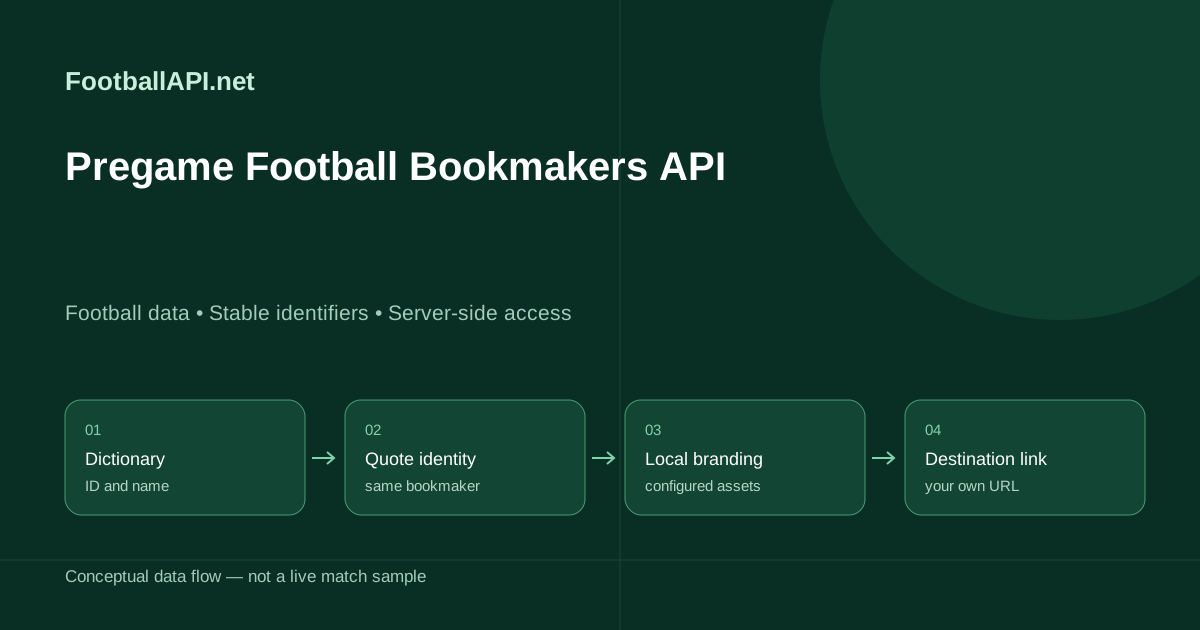
Keep bookmaker IDs as strings and attach the supplied name as a mutable label. When processing an available price record, join using its bookmaker identifier rather than a case-insensitive substring match against the name. A local label may be shorter for a mobile table, but it should not change which operator the record represents. Preserve unfamiliar identifiers in diagnostics and use an explicit unmapped state until their definitions are known. Guessing a familiar operator from a similar name can attach the wrong logo, destination link or history to a price. That is a data-integrity error even if the numerical odds themselves have been copied correctly.
A directory entry is not a current quote
A bookmaker can appear in the dictionary while supplying no current price for the selected game or market. It may cover other competitions, different markets or a different pregame window. Build comparison rows from real available quote records, not by drawing every bookmaker in the directory and filling missing prices with guessed defaults. If your design retains unavailable rows for context, label them clearly and do not make them look like active offers. Keep suspended quotes distinct from absent quotes, and preserve source timestamps where supplied. Refreshing names cannot fix a missing quote or activate an account that does not have access to the underlying odds operation.
Applying bookmaker filters to bounded price requests
The dictionary provides identities for the pregame odds bm filter. Use the published price contract and an appropriately narrow match, competition or market scope when that service is enabled for your account. Do not assume that every REST operation accepts bm or that supplying it to the dictionary changes which definitions are returned. Separate the reference-data job from your price-refresh worker: the former prepares labels, while the latter handles changing quotes, suspensions and timestamps. Cache both according to their own contracts. This arrangement reduces redundant requests and makes it easier to explain whether a missing display element is an identity problem or a genuine lack of price data.
Logos are presentation assets, not dictionary output
Bookmaker names and IDs do not establish a right to use every associated logo, nor do they guarantee that the dictionary contains image files. Configure properly sourced brand assets separately and associate each with the intended bookmaker ID. A solid background can improve legibility in an odds table, but it must not hide the operator's identity or imply endorsement. Use accessible alternative text, preserve sensible dimensions and avoid substituting one bookmaker's branding when another asset is unavailable. Keep the data mapping usable even without images so a failed logo download does not remove a real price or make the comparison table impossible to understand.
Customer links and affiliate destinations are separate
A bookmaker definition is not an affiliate link. If your widget or application allows configured destination URLs, the operator must provide and maintain those URLs independently. Match the configured link to the correct bookmaker identity and apply it only to the intended quote boxes or labels. Validate URL schemes, avoid embedding secrets and use appropriate disclosures and link attributes where commercial relationships apply. Do not construct a supposedly official deep link from the bookmaker name or an undocumented identifier. If no destination has been configured, a price can remain readable without becoming a misleading link to another operator or an unrelated landing page.
Do not carry pregame assumptions into in-play products
This is a pregame bookmaker dictionary. A separately configured live-odds service may have different reference endpoints, identifiers, transport details and access requirements. The existence of a pregame operator ID does not establish that the same operator is available in play or that a mapping can be inferred by numeric similarity. Keep those namespaces explicit until a verified mapping is available. Some specialist live services require registering public server IP addresses with FootballAPI.net; this ordinary dictionary request does not perform that setup. Likewise, obtaining a dictionary is not a settlement confirmation and cannot determine whether a particular selection has won or lost.
Maintain labels without corrupting historical comparisons
Retain the bookmaker ID with every stored quote so a later label change does not break historical joins. If your reports need to reproduce the exact presentation at capture time, also save a dated display-name snapshot or mapping revision. Keep rebranding separate from the underlying operator identity rather than deleting and recreating all historical rows under a new name. When an ID disappears from the current dictionary, preserve old quote records and investigate before remapping it. This approach lets your application update current branding while still explaining which operator supplied a price recorded earlier, without pretending the latest dictionary describes the history of every brand.
A practical checklist for bookmaker comparisons
Test a recognized bookmaker, an unfamiliar ID, a renamed label, a missing logo and a record without a configured destination. Confirm that sorting by best price does not accidentally detach the operator name from its quote or move the wrong outbound link with it. On mobile, keep names readable even when the table scrolls horizontally or displays only a few bookmakers. Validate empty and partial dictionaries, retain your previous valid mapping during errors and log request IDs without credentials. The API reference defines actual request behavior; combine it with the market dictionary guide before comparing selections so both the operator and the wager are matched correctly.
Questions developers ask
- Does this endpoint return bookmaker logos?
- Do not assume so. Its purpose is supplied identifiers and names; configure properly sourced visual assets separately.
- Are affiliate URLs included?
- No affiliate destination is promised. Configure your own valid links independently of the reference mapping.
- Does every listed bookmaker offer prices for my fixture?
- No. Build availability from actual quotes returned by your enabled odds service.
- Which filter uses these identifiers?
- The pregame odds contract uses bm. Other services may have different parameters or identifiers.
- Can these IDs activate live-odds access?
- No. In-play access, mappings and any IP registration are separate requirements.
Guides and documentation
Check the plan before you write the integration.
Starter £29, Growth £99, Pro £249 per month. Starter only: 7 days free, once per account, card required. Then £29/month unless cancelled. No VAT currently charged. Existing EUR subscriptions are unchanged.